For wholesale, sophisticated and professional investors and their financial advisers only.
Seeking alternatives to bank hybrids in Australia? As APRA removes hybrids from the bank capital framework, structured products such as Fixed Coupon Notes are one way advisers are rebuilding the income sleeve. They generate income from different risks: listed reference assets and the credit of a named issuing bank, with the coupon, term and barrier set before investing. They are not a like-for-like replacement: coupons carry no franking credits and capital is at risk below the downside barrier.
If you are evaluating hybrid replacements, book a consultation with our investment desk.
What Is a Bank Hybrid?
A bank hybrid is a security issued by a bank that combines features of debt and equity. For many clients, hybrids have been a cornerstone of the income sleeve, sitting between bonds and shares.

Key features:
- A floating distribution, a margin over the bank bill swap rate (BBSW), so income moves with short-term rates
- Distributions typically carry franking credits
- Perpetual, with calls at the issuing bank's discretion
- Rank below senior debt in the bank's capital structure
- Can convert into ordinary shares in certain conditions
- Listed on the ASX and traded at market price
What Is a Structured Product?
A structured product is a pre-packaged investment strategy designed to meet a specific objective over a defined term.
Key features:
- Issued by an investment bank, named in the term sheet
- Linked to listed reference assets such as shares, indices or ETFs
- The coupon, term, barrier and issuer are set before investing
- Fixed maturity, typically 6 months to 5 years
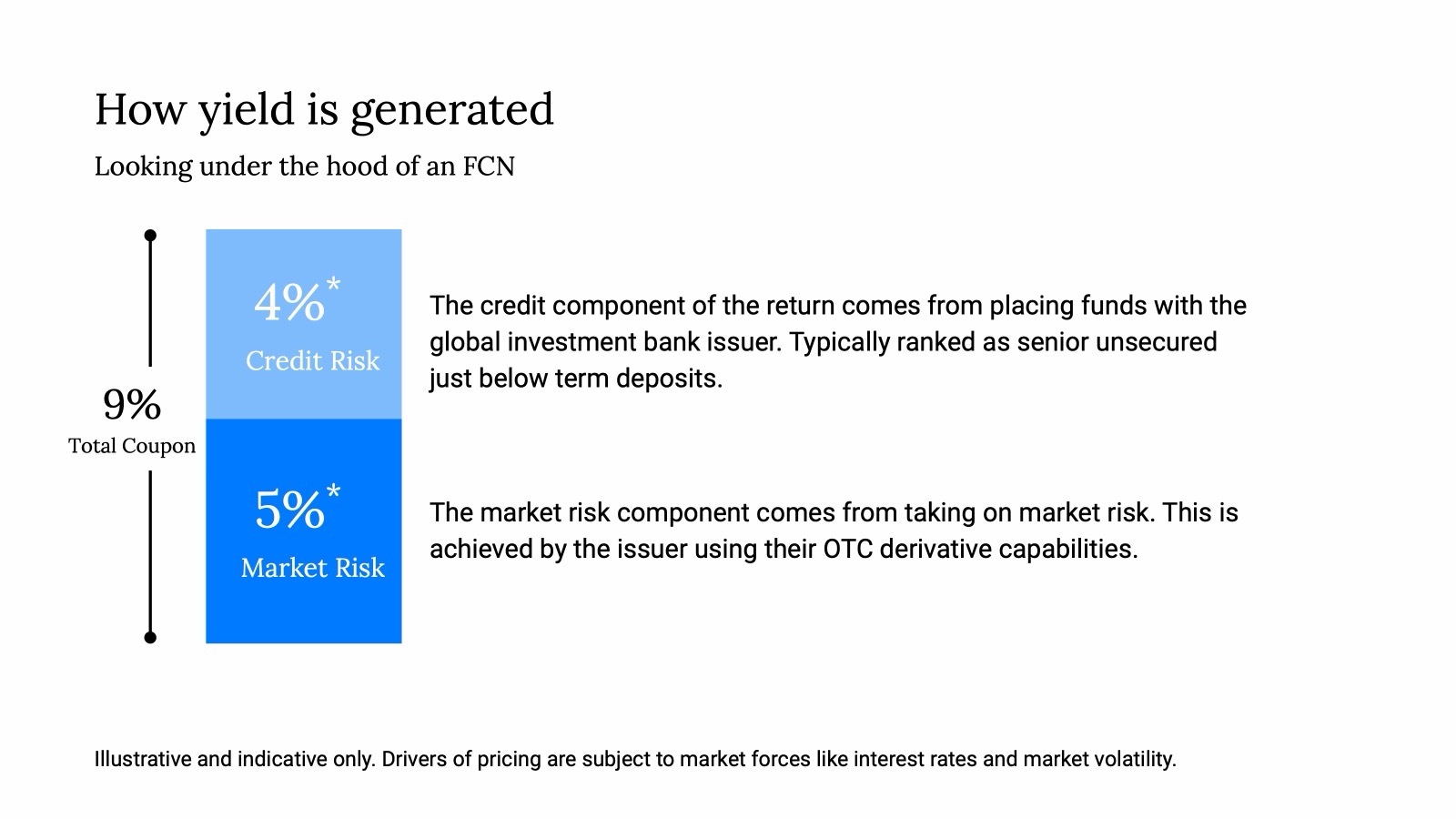
For income, the most common structure is the Fixed Coupon Note. It pays a fixed coupon monthly or quarterly, and returns capital in full at maturity provided none of the reference assets finish below the downside barrier, subject to the issuer meeting its obligations. The coupon has two parts: the funding rate the issuing bank pays for holding the investor's capital, and a premium for taking on market risk over the reference assets. Interest rates and volatility are the two main drivers of pricing.
Similarities Between Bank Hybrids and Structured Products
- Income: both can be used to generate regular income for a portfolio.
- Bank credit risk: both depend on a bank meeting its obligations. For a hybrid it is the issuing Australian bank; for a structured product it is the issuing bank named in the term sheet.
Key Differences Between Bank Hybrids and Structured Products
How Is Income Generated?
A bank hybrid pays a floating distribution that moves with short-term rates. A Fixed Coupon Note pays a coupon fixed at issue, subject to the issuer meeting its obligations; a higher coupon reflects more market risk, such as more volatile reference assets or a higher barrier.
What About Franking?
Hybrid distributions typically carry franking credits. Fixed Coupon Note coupons are interest payments from the issuing bank and carry no franking credits, so clients who valued hybrids for franking will see a different after-tax outcome. Tax outcomes depend on individual circumstances.
How Long Is the Term?
Hybrids are perpetual, with calls at the issuing bank's discretion. Structured products have a fixed maturity; for income, advisers typically use 3 to 24 months, which lets them reset coupons and barriers as markets change.
Can You Exit Early?
Hybrids are listed on the ASX and traded at market price. With a structured product, during normal market conditions investors may redeem at any point over the term, subject to a 1% bid/ask spread.
Where Do They Rank?
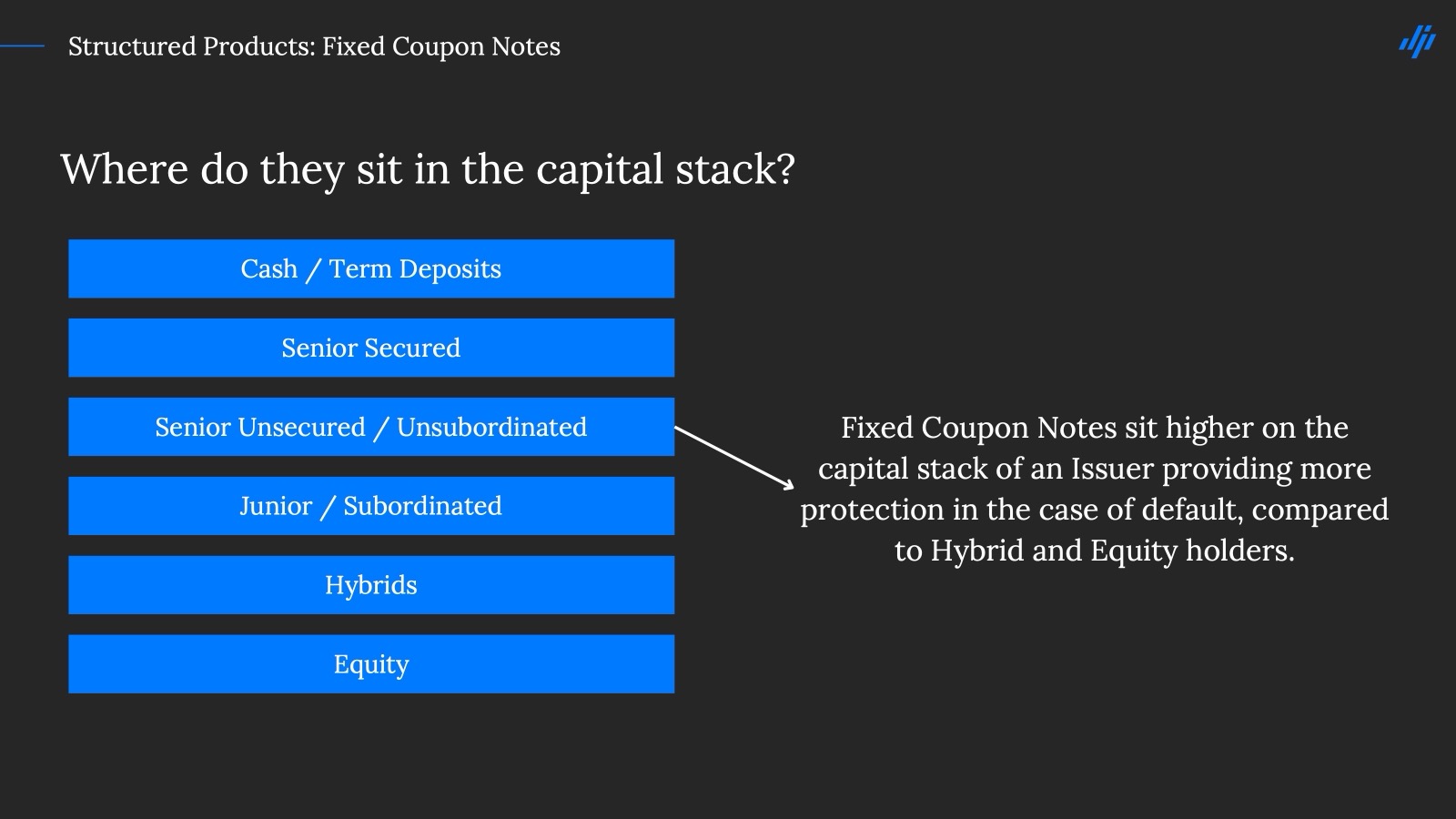
Hybrids are subordinated, below senior debt, and can convert into ordinary shares. Notes typically rank as senior unsecured obligations of the issuer, above hybrid and equity holders. Senior ranking does not mean lower risk overall: a Fixed Coupon Note adds market risk on the reference assets.
What Happens to Capital at Maturity?
A hybrid has no fixed maturity: what the investor gets back depends on whether the bank calls the security, its market price and any conversion into ordinary shares. In a Fixed Coupon Note, the downside barrier decides the outcome: if any reference asset finishes below it at maturity, investors incur a capital loss equal to the fall in the worst performing asset from its initial level.
An example. Take an illustrative three-year note linked to ANZ, Commonwealth Bank, Westpac and NAB, paying 8% p.a. in quarterly coupons: $2,000 each quarter on $100,000. The downside barrier is 50% of each share's starting price, tested only at maturity. If all four finish at or above it, capital is returned in full. If the worst performer has fallen 60%, $40,000 of the original $100,000 is repaid, with coupons already received retained. The four banks are the reference shares that decide the payoff; they are not automatically the issuer.

“Aussie investors are very familiar with the banks, like they were when they were investing in hybrids. They are comfortable with the balance sheet risk.”
Anto Joseph, CEO, Stropro
For investors willing to own shares, a Smart-Entry Income Note pays a higher coupon in exchange for agreeing to buy the worst-performing reference share at a pre-agreed level, set below the starting price, if it finishes below that level at maturity. Our COO, Ben Streater, works through an example in Hybrid Alternatives That Are Not Private Credit.
Both structures are illustrative, not live quotes, and are not comparable to hybrid yields.
When to Use Each
- Consider holding existing hybrids when franking credits matter most to the client and a listed, floating-rate exposure to an Australian bank suits the portfolio, noting APRA's transition away from hybrids.
- Consider structured products when you want income with every term set upfront, a fixed term, the ability to exit over the term in normal market conditions, and senior ranking with the issuer, and franking is not the deciding factor.
For a client whose hybrids are being called, the question is where that income goes next, and which risks it should come from.
Source: Stropro CPD webinar, Beyond Hybrids and Private Credit; APRA.
What Has Changed for Bank Hybrids
- APRA has finalised the removal of Additional Tier 1 capital, commonly referred to as hybrids, from Australia's bank prudential framework. The new standards commence on 1 January 2027, and existing instruments have transitional arrangements (APRA, 4 December 2025).
- As a reference point for the income being replaced, at 30 September 2026 the Betashares Australian Major Bank Hybrids Index ETF reported a portfolio net running yield of 5.31% and a gross running yield of 7.39%, the latter including the full benefit of franking credits (Betashares BHYB factsheet).
Summary
Bank hybrids offered franked, floating-rate income from familiar banks, with equity-like risks underneath. Structured products offer income with every term known before investing, a fixed term and senior ranking with the issuer, with no franking, capital at risk below the downside barrier and exposure to the issuer's credit. Through Stropro, advisers can price structured products across a panel of 12 global investment banks and compare the terms side by side. For clients who also hold private credit, see Structured Products vs Private Credit. For a comparison of vehicles, see ETFs vs Structured Products.
If you are evaluating hybrid replacements, book a consultation with our investment desk.
Frequently Asked Questions
What are the alternatives to bank hybrids in Australia?
Advisers rebuilding the income sleeve often consider structured products such as Fixed Coupon Notes, which pay a coupon set at issue over a fixed term, linked to listed reference assets and the credit of a named issuing bank. Coupons carry no franking credits and capital is at risk. (Adviser Trends, September Quarter 2025).
What is happening to bank hybrids?
APRA has finalised the removal of Additional Tier 1 capital from the bank prudential framework. New standards commence on 1 January 2027, and existing instruments have transitional arrangements.
Are Fixed Coupon Note coupons franked?
No. Coupons are interest payments from the issuing bank and carry no franking credits.
Can I exit these strategies early?
Yes, during normal market conditions, investors may redeem units at any point over the term. Redemptions are subject to a 1% bid/ask spread. The exit price will depend on a wide variety of factors, most notably: time left in the product, current price of the reference assets and volatility.
What decides whether capital is returned at maturity?
The downside barrier. If none of the reference assets finish below it at maturity, capital is returned in full, subject to the issuer's credit. If any do, investors incur a capital loss equal to the fall in the worst performing asset from its initial level.
Where does a note rank if the issuer becomes insolvent?
Notes typically rank as senior unsecured obligations of the issuer, above hybrid and equity holders. Investors are exposed to the issuer's credit risk.
Can a self-managed super fund invest?
Yes. Fixed Coupon Notes are fully funded and can be held in a self-managed super fund, subject to the fund's investment strategy and wholesale investor eligibility.
How quickly can a new note be set up?
In less than 24 hours from the request, depending on timing and the issuer.
Important Information
Wholesale Investors only. Subject to credit risk of the issuer. Tax outcomes depend on individual circumstances and applicable tax law, and may be subject to change. Investors should seek independent tax advice.
Investments made available on the Stropro platform are only available to wholesale, sophisticated or professional investors and their financial advisers. Information is general in nature. Please consider whether the information and investments are suitable for you and your personal circumstances. Stropro Operations Pty Ltd (ABN 28 633 603 399) (Stropro) is a Corporate Authorised Representative (CAR No. 1293257) of Stropro Compliance Pty Ltd (ABN 74 640 214 740, AFSL No. 533443). Stropro Operations Pty Ltd and Stropro Compliance Pty Ltd are subsidiaries of Stropro Technologies Pty Ltd (ABN 80 619 399 932).