For wholesale, sophisticated and professional investors and their financial advisers only.
Seeking alternatives to private credit in Australia? Structured products such as Fixed Coupon Notes can also generate income, but from different risks: listed reference assets and the credit of a named issuing bank, with the coupon, term and barrier set before investing.
If you are reviewing a private credit allocation, book a consultation with our investment desk.
What Is Private Credit?
Private credit refers to debt agreements made privately between borrowers and lenders, without trading on public markets. These loans are typically illiquid but can offer higher yields compared to their public counterparts.
Key features:
- Income from interest paid by private borrowers
- Accessed through funds, often with multi-year terms and limits on redemptions
- Loans are valued by the manager rather than priced on a market
- Australian funds are typically concentrated in real estate lending, including construction and development (RBA, October 2026)
- Covers very different strategies, from direct lending and real estate lending to venture debt, distressed debt and mezzanine financing, each with its own risk
What Is a Structured Product?
A structured product is a pre-packaged investment strategy designed to meet a specific objective over a defined term.
Key features:
- Issued by an investment bank, named in the term sheet
- Linked to listed reference assets such as shares, indices or ETFs
- The coupon, term, barrier and issuer are set before investing
- Fixed maturity, typically 6 months to 5 years
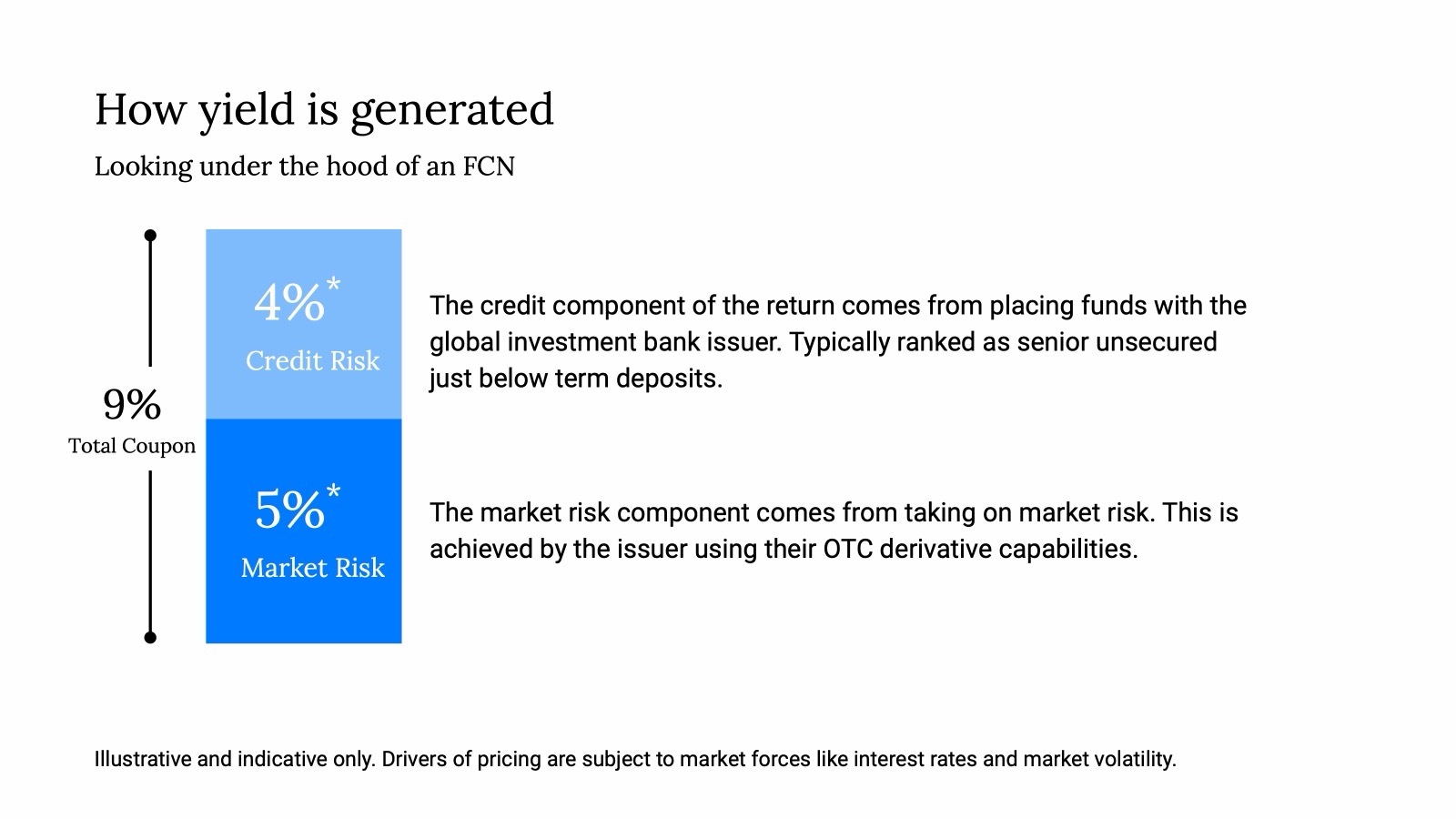
For income, the most common structure is the Fixed Coupon Note. It pays a fixed coupon monthly or quarterly, and returns capital in full at maturity provided none of the reference assets finish below the downside barrier, subject to the issuer meeting its obligations. The coupon has two parts: the funding rate the issuing bank pays for holding the investor's capital, and a premium for taking on market risk over the reference assets. Interest rates and volatility are the two main drivers of pricing.
Similarities Between Private Credit and Structured Products
- Income: both can be used to generate regular income for a portfolio.
- Credit risk: both depend on someone meeting their obligations. For private credit it is the borrowers; for a structured product it is the issuing bank.
Key Differences Between Private Credit and Structured Products
Who Are You Exposed To?
Private credit spreads capital across private borrowers selected by the manager. A structured product carries the credit risk of one named issuing bank, plus the market risk of the reference assets the adviser chooses.
How Is Income Generated?
Private credit income depends on borrowers continuing to pay interest. A Fixed Coupon Note pays a coupon agreed at issue, subject to the issuer meeting its obligations; a higher coupon reflects more market risk, such as more volatile reference assets or a higher barrier. Higher yields also come at a cost: they mean heavier repayments for borrowers, which can push defaults up, and when lenders extend loan terms to avoid defaults, investor returns can be diluted.
How Long Is the Term?
Private credit funds often run multi-year terms with limits on redemptions. Structured products have a fixed maturity; for income, advisers typically use 6 to 24 months, which lets them reset coupons and barriers as markets change.
Can You Exit Early?
Private credit redemptions can be limited, and ASIC notes that liquidity buffers are tightening. With a structured product, during normal market conditions investors may redeem at any point over the term, subject to a 1% bid/ask spread.
How Are They Valued?
Private credit loans are valued by the manager. In June 2026, ASIC warned that weaker borrower conditions increase the risk that reported valuations do not fully reflect underlying conditions. A structured product's exit price depends on time left in the product, the current price of the reference assets and volatility.
“There are quality private credit funds out there. But there is a lot of complexity in a credit transaction, which many investors may not be privy to, and may realise too late.”
Anto Joseph, CEO, Stropro
What Happens to Capital at Maturity?
In private credit, losses come from borrowers failing to repay. In a Fixed Coupon Note, the downside barrier decides the outcome: if any reference asset finishes below it at maturity, investors incur a capital loss equal to the fall in the worst performing asset from its initial level.
When to Use Each
- Consider private credit when illiquidity is acceptable, spreads compensate, and the manager's lending adds exposure the portfolio does not already have.
- Consider structured products when you want income with every term set upfront, shorter horizons, the ability to exit over the term in normal market conditions, and exposure to listed assets.
For a client already well allocated to private credit, the question is whether the next dollar adds to the same exposure or comes from a different source of income.
“For us, the focus is how we expand the income toolkit.”
Anto Joseph, CEO, Stropro
Use this matrix to align objectives, liquidity and drawdown preferences. Source: Stropro, Adviser Trends Report, September Quarter 2025.
What Has Changed in Private Credit
- ASIC has made poor practices in private credit a 2026 enforcement priority, with multiple investigations underway. For advisers, valuation and liquidity practices become a due diligence point.
- Most funds continue to manage liquidity adequately, although ASIC notes buffers are tightening.
- The RBA reports that a recent large property developer insolvency has led to increased redemption requests and tighter funding for some Australian funds, while most loans continue to perform and are well collateralised. A client can hold what looks like a diversified income fund and still carry a concentrated property exposure.
- J.P. Morgan Asset Management notes that sector-specific challenges require heightened diligence in manager selection, and that private credit should be treated as a long-term investment because withdrawals can be limited in times of stress.
Summary
Private credit offers access to private lending selected by a specialist manager. Structured products offer income with every term known before investing, shorter horizons and exposure to listed assets, with capital at risk below the downside barrier and exposure to the issuer's credit. Through Stropro, advisers can price structured products across a panel of 12 global investment banks and compare the terms side by side. For clients replacing bank hybrids as well, see Structured Products vs Bank Hybrids. For a comparison of vehicles, see ETFs vs Structured Products.
If you are reviewing a private credit allocation, book a consultation with our investment desk.
Frequently Asked Questions
What are the alternatives to private credit in Australia?
Advisers seeking income from a different source often consider structured products such as Fixed Coupon Notes, which pay a coupon set at issue over a fixed term, linked to listed reference assets and the credit of a named issuing bank. Capital is at risk.
Are structured products a replacement for private credit?
Not necessarily. They generate income from different risks: listed reference assets and the credit of a named issuing bank, rather than loans to private borrowers. Their terms are set before investing, they are shorter, and investors can exit over the term in normal market conditions.
Can I exit these strategies early?
Yes, during normal market conditions, investors may redeem units at any point over the term. Redemptions are subject to a 1% bid/ask spread. The exit price will depend on a wide variety of factors, most notably: time left in the product, current price of the reference assets and volatility.
What decides whether capital is returned at maturity?
The downside barrier. If none of the reference assets finish below it at maturity, capital is returned in full, subject to the issuer's credit. If any do, investors incur a capital loss equal to the fall in the worst performing asset from its initial level.
Where does a note rank if the issuer becomes insolvent?
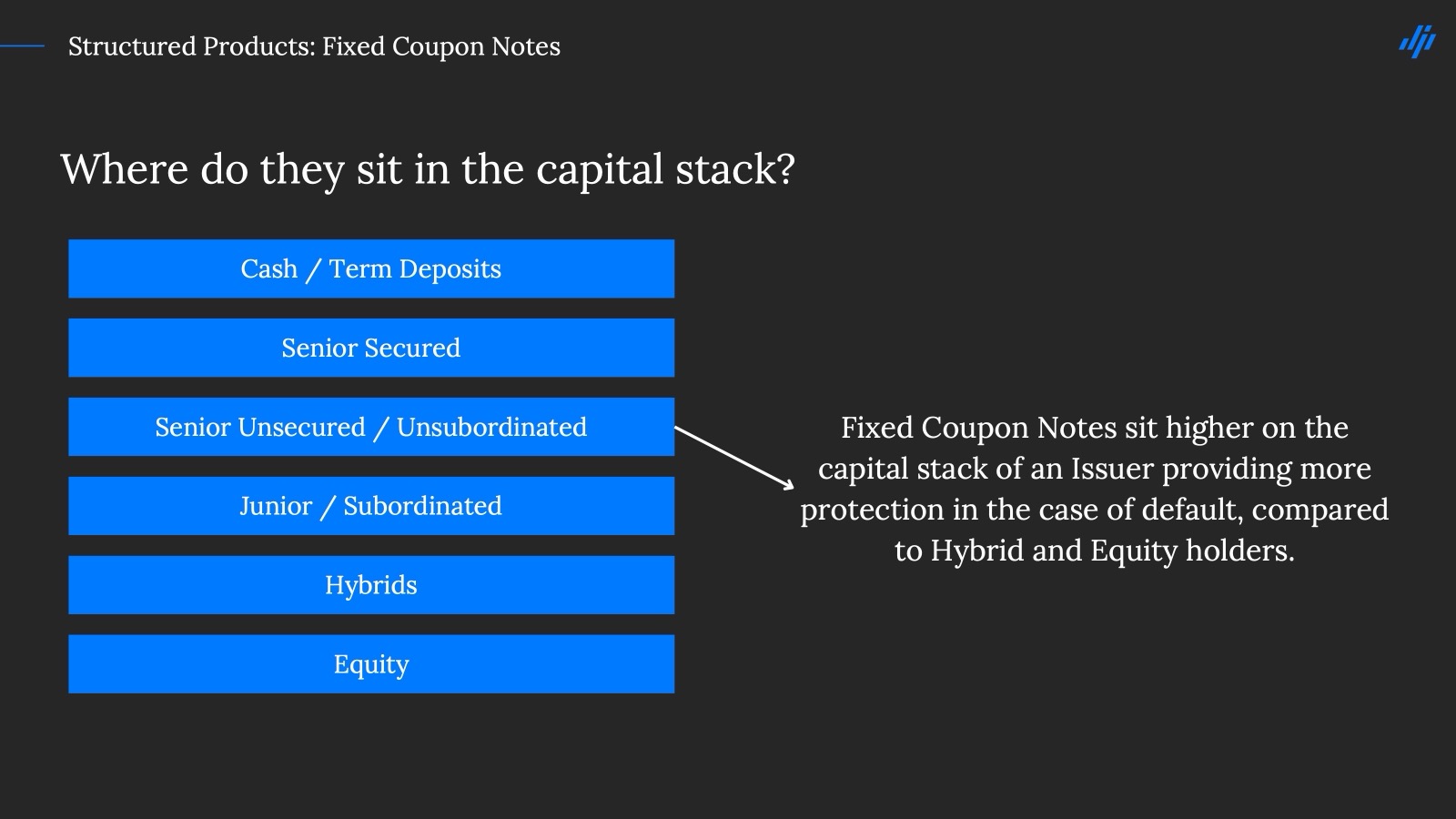
Notes typically rank as senior unsecured obligations of the issuer, above hybrid and equity holders. Investors are exposed to the issuer's credit risk.
Can a self-managed super fund invest?
Yes. Fixed Coupon Notes are fully funded and can be held in a self-managed super fund, subject to the fund's investment strategy and wholesale investor eligibility.
How quickly can a new note be set up?
In less than 24 hours from the request, depending on timing and the issuer.
Important Information
Wholesale Investors only. Subject to credit risk of the issuer.
Investments made available on the Stropro platform are only available to wholesale, sophisticated or professional investors and their financial advisers. Information is general in nature. Please consider whether the information and investments are suitable for you and your personal circumstances. Stropro Operations Pty Ltd (ABN 28 633 603 399) (Stropro) is a Corporate Authorised Representative (CAR No. 1293257) of Stropro Compliance Pty Ltd (ABN 74 640 214 740, AFSL No. 533443). Stropro Operations Pty Ltd and Stropro Compliance Pty Ltd are subsidiaries of Stropro Technologies Pty Ltd (ABN 80 619 399 932).